
The best
AI tool for literature review
in pharmacovigilance
Distill actionable insights from a mountain of published evidence
in a matter of minutes.
Distill actionable insights from a mountain of published evidence in a matter of minutes.
What are we scanning literature for today?
I am writing a PSUR for Ibuprofen
Try it out
Popular use cases
I am writing a PSUR
I am looking for ICSR cases
I am writing a Clinical document
I need to find answer to a Medical Affair
I wish to evaluate an idea
What are we scanning literature for today?
I am writing a PSUR for Ibuprofen
Popular use cases
I am writing a PSUR
I am looking for ICSR cases
I am writing a Clinical document
I need to find answer to a Medical Affair
I wish to evaluate an idea
AI-POWERED FEATURES
POWERFUL YET EASY TO USE
How does it work? Quick and simple
1
Pose a research question
Simply type what you are looking
for or choose a predefined search scenario.
2
Adjust search settings
Syntro will prefill search criteria for you, including both keywords and query.
3
Wait a minute or two…
… for Syntro to do its analytical magic.
4
Enjoy the analysis results
… for Syntro to do its analytical magic.
What is your Research Question?
Has anemia been reported in people taking paracetamol? If so, at what dose did it occure?
or choose a Research Scenario
I am writing a PSUR
I am looking for ICSR cases
I am writing a Clinical doc
I need to find an answer to a Medical Affair
I wish to evaluate an idea
Keywords
Drug:
paracetamol
acetaminophen
acetaminophen[MeSh]
paracetamol[MeSh]
Condition:
anemia
anaemia
anemia[MeSh]
hemolytic anemia
aplastic anemia
Other:
adverse effects
side effects
toxicity
dose
dosage
mg
mg/kg
Resulted query
((paracetamol[tiab] OR acetaminophen[tiab] OR acetaminophen[MeSH][tiab] OR paracetamol[tiab][tiab] OR acetaminophen[tiab][tiab] OR tylenol[tiab]) AND (anemia[tiab] OR anaemia[tiab] OR Anemia[MeSH][tiab] OR "hemolytic anemia"[tiab] OR "aplastic anemia"[tiab] OR pancytopenia[tiab] OR "blood dyscrasia"[tiab] OR "bone marrow suppression"[tiab]) AND ("adverse effects"[tiab] OR "side effects"[tiab] OR toxicity[tiab] OR "hematologic toxicity"[tiab] OR hemolysis[tiab] OR dose[tiab] OR dosage[tiab] OR overdose[tiab] OR high-dose[tiab] OR "therapeutic dose"[tiab] OR "chronic use"[tiab] OR "long-term use"[tiab])) AND humans[Filter]
What is your Research Question?
Has anemia been reported in people taking paracetamol? If so, at what dose did it occure?
or choose a Research Scenario
I am writing a PSUR
I am looking for ICSR cases
I am writing a Clinical doc
I need to find an answer to a Medical Affair
I wish to evaluate an idea
Keywords
Drug:
paracetamol
acetaminophen
acetaminophen[MeSh]
paracetamol[MeSh]
Condition:
anemia
anaemia
anemia[MeSh]
hemolytic anemia
aplastic anemia
Other:
adverse effects
side effects
toxicity
dose
dosage
mg
mg/kg
Resulted query
((paracetamol[tiab] OR acetaminophen[tiab] OR acetaminophen[MeSH][tiab] OR paracetamol[tiab][tiab] OR acetaminophen[tiab][tiab] OR tylenol[tiab]) AND (anemia[tiab] OR anaemia[tiab] OR Anemia[MeSH][tiab] OR "hemolytic anemia"[tiab] OR "aplastic anemia"[tiab] OR pancytopenia[tiab] OR "blood dyscrasia"[tiab] OR "bone marrow suppression"[tiab]) AND ("adverse effects"[tiab] OR "side effects"[tiab] OR toxicity[tiab] OR "hematologic toxicity"[tiab] OR hemolysis[tiab] OR dose[tiab] OR dosage[tiab] OR overdose[tiab] OR high-dose[tiab] OR "therapeutic dose"[tiab] OR "chronic use"[tiab] OR "long-term use"[tiab])) AND humans[Filter]
Pose a research question
Simply type what you are looking for or choose a predefined search scenario.
AI-POWERED FEATURES
What Syntro actually does for you?
Search strategy optimization
Suggests keywords based on your Research Question and dynamically formulates proper search query.
Analyzing
Keywords
Drug:
paracetamol
acetaminophen
acetaminophen[MeSh]
paracetamol[MeSh]
Condition:
anemia
anaemia
anemia[MeSh]
hemolytic anemia
aplastic anemia
Other:
adverse effects
side effects
toxicity
dose
dosage
mg
mg/kg
mg/kg
Resulted query
((paracetamol[tiab] OR acetaminophen[tiab] OR acetaminophen[MeSH][tiab] OR paracetamol[tiab][tiab] OR acetaminophen[tiab][tiab] OR tylenol[tiab]) AND (anemia[tiab] OR anaemia[tiab] OR Anemia[MeSH][tiab] OR "hemolytic anemia"[tiab] OR "aplastic anemia"[tiab] OR pancytopenia[tiab] OR "blood dyscrasia"[tiab] OR "bone marrow suppression"[tiab]) AND ("adverse effects"[tiab] OR "side effects"[tiab] OR toxicity[tiab] OR "hematologic toxicity"[tiab] OR hemolysis[tiab] OR dose[tiab] OR dosage[tiab] OR overdose[tiab] OR high-dose[tiab] OR "therapeutic dose"[tiab] OR "chronic use"[tiab] OR "long-term use"[tiab])) AND humans[Filter]
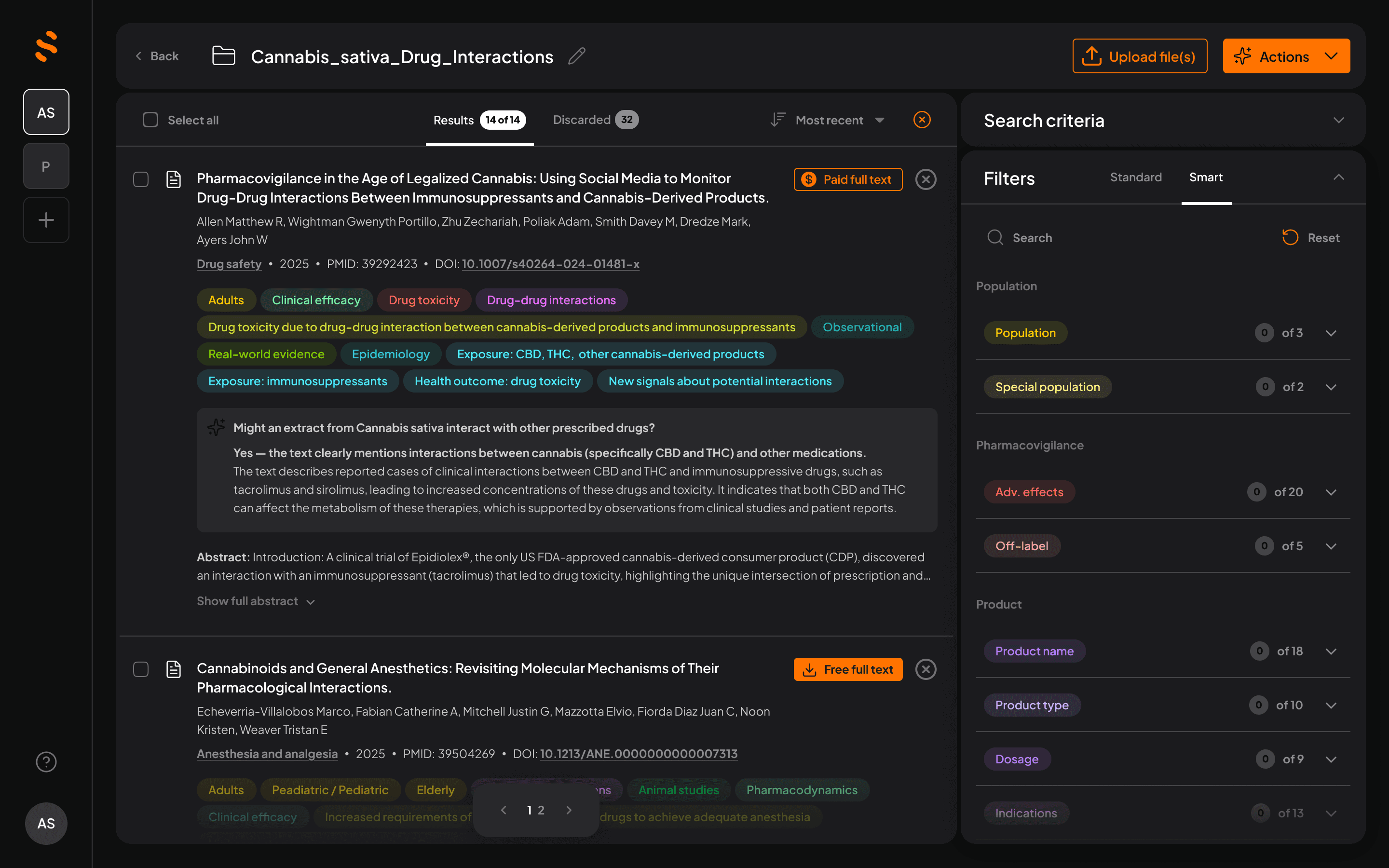
Smart contextual analysis
Extracts and tags crucial information from the publication and answers the Research Question.
Glucose-6-phosphate dehydrogenase deficiency: an unusual cause of acute jaundice after paracetamol overdose
Phillpotts Simon, Tash Elliot, Sen Sambit
European Journal of Haematology ∙ 2024 ∙ PMID: 41514457 ∙ DOI: 10.1111/ejh.12330
Analyzing
Adults
Paracetamol
Heamolytic anaemia
Acute jaundiceytic
Overdose
Glucose-6-phosphate dehydrogenase deficiency
and 4 more
Has anemia been reported in people taking paracetamol? If so, at what dose did it occure?
Yes — the abstract states that paracetamol-induced haemolysis (haemolytic anaemia) has been reported in people with G6PD deficiency and describes an adult case that occurred after a paracetamol overdose. The abstract does not specify the dose of paracetamol involved.
Abstract: Glucose-6-phosphate dehydrogenase (G6PD) deficiency is the commonest human enzyme defect causing haemolytic anaemia after exposure to specific triggers. Paracetamol-induced haemolysis in G6PD deficiency is a rare complication and mostly reported in children. We report the first case (to the best of our knowledge) of acute jaundice without overt clinical features of a haemolytic crisis, in an otherwise healthy adult female following paracetamol overdose, due to previously undiagnosed G6PD deficiency. It is important that clinicians consider this condition when a patient presents following a paracetamol overdose with significant and disproportionate jaundice, without transaminitis or coagulopathy.
Show full abstract
Adults
Paracetamol
Heamolytic anaemia
Acute jaundiceytic
Overdose
Glucose-6-phosphate dehydrogenase deficiency
and 4 more
Has anemia been reported in people taking paracetamol? If so, at what dose did it occure?
Yes — the abstract states that paracetamol-induced haemolysis (haemolytic anaemia) has been reported in people with G6PD deficiency and describes an adult case that occurred after a paracetamol overdose. The abstract does not specify the dose of paracetamol involved.
Intelligent screening
Automated triage: prioritizing high-impact evidence while filtering noise and categorizing by key themes.
Glucose-6-phosphate dehydrogenase deficiency: an unusual cause of acute jaundice after paracetamol overdose
Phillpotts Simon, Tash Elliot, Sen Sambit
European Journal of Haematology ∙ 2024 ∙ PMID: 41514457 ∙ DOI: 10.1111/ejh.12330
Adults
Paracetamol
Heamolytic anaemia
Acute jaundiceytic
Overdose
Glucose-6-phosphate dehydrogenase deficiency
and 4 more
Has anemia been reported in people taking paracetamol? If so, at what dose did it occure?
Yes — the abstract states that paracetamol-induced haemolysis (haemolytic anaemia) has been reported in people with G6PD deficiency and describes an adult case that occurred after a paracetamol overdose. The abstract does not specify the dose of paracetamol involved.
Abstract: Glucose-6-phosphate dehydrogenase (G6PD) deficiency is the commonest human enzyme defect causing haemolytic anaemia after exposure to specific triggers. Paracetamol-induced haemolysis in G6PD deficiency is a rare complication and mostly reported in children. We report the first case (to the best of our knowledge) of acute jaundice without overt clinical features of a haemolytic crisis, in an otherwise healthy adult female following paracetamol overdose, due to previously undiagnosed G6PD deficiency. It is important that clinicians consider this condition when a patient presents following a paracetamol overdose with significant and disproportionate jaundice, without transaminitis or coagulopathy.
Show full abstract
Selected
23
Discarded
58
Does Intravenous Acetaminophen Reduce Opioid Requirement in Pediatric Emergency Department Patients With
Dhebaria Tina, Sivitz Adam, Tejani Cena
European Journal of Haematology ∙ 2024 ∙ PMID: 41514457 ∙ DOI: 10.1111/ejh.12330
Pediatric
Efficacy
Amlodipine (15mg/kg IV)
Morphine (0.1mg/kg IV)
Acetomenophen
Mophene
Placebo
and 9 more
Has anemia been reported in people taking paracetamol? If so, at what dose did it occure?
No — the trial abstract reports that adverse events were assessed and that “There were no clinical or statistically significant differences between the rates of admission, 72-hour return visits, or adverse events,” but it does not mention anemia or any specific hematologic adverse events or doses at which such events occurred. Therefore the abstract provides no data on whether anemia has been reported with paracetamol/acetaminophen or the dose associated with it.
Abstract: Glucose-6-phosphate dehydrogenase (G6PD) deficiency is the commonest human enzyme defect causing haemolytic anaemia after exposure to specific triggers. Paracetamol-induced haemolysis in G6PD deficiency is a rare complication and mostly reported in children. We report the first case (to the best of our knowledge) of acute jaundice without overt clinical features of a haemolytic crisis, in an otherwise healthy adult female following paracetamol overdose, due to previously undiagnosed G6PD deficiency. It is important that clinicians consider this condition when a patient presents following a paracetamol overdose with significant and disproportionate jaundice, without transaminitis or coagulopathy.
Show full abstract
Selected
23
Discarded
58
Glucose-6-phosphate dehydrogenase deficiency: an unusual cause of acute jaundice after paracetamol overdose
Phillpotts Simon, Tash Elliot, Sen Sambit
European Journal of Haematology ∙ 2024 ∙ PMID: 41514457 ∙ DOI: 10.1111/ejh.12330
Adults
Paracetamol
Heamolytic anaemia
Acute jaundiceytic
Overdose
Glucose-6-phosphate dehydrogenase deficiency
and 4 more
Has anemia been reported in people taking paracetamol? If so, at what dose did it occure?
Yes — the abstract states that paracetamol-induced haemolysis (haemolytic anaemia) has been reported in people with G6PD deficiency and describes an adult case that occurred after a paracetamol overdose. The abstract does not specify the dose of paracetamol involved.
Abstract: Glucose-6-phosphate dehydrogenase (G6PD) deficiency is the commonest human enzyme defect causing haemolytic anaemia after exposure to specific triggers. Paracetamol-induced haemolysis in G6PD deficiency is a rare complication and mostly reported in children. We report the first case (to the best of our knowledge) of acute jaundice without overt clinical features of a haemolytic crisis, in an otherwise healthy adult female following paracetamol overdose, due to previously undiagnosed G6PD deficiency. It is important that clinicians consider this condition when a patient presents following a paracetamol overdose with significant and disproportionate jaundice, without transaminitis or coagulopathy.
Show full abstract
Selected
23
Does Intravenous Acetaminophen Reduce Opioid Requirement in Pediatric Emergency Department Patients With
Dhebaria Tina, Sivitz Adam, Tejani Cena
European Journal of Haematology ∙ 2024 ∙ PMID: 41514457 ∙ DOI: 10.1111/ejh.12330
Pediatric
Efficacy
Amlodipine (15mg/kg IV)
Morphine (0.1mg/kg IV)
Acetomenophen
Mophene
Placebo
and 9 more
Has anemia been reported in people taking paracetamol? If so, at what dose did it occure?
No — the trial abstract reports that adverse events were assessed and that “There were no clinical or statistically significant differences between the rates of admission, 72-hour return visits, or adverse events,” but it does not mention anemia or any specific hematologic adverse events or doses at which such events occurred. Therefore the abstract provides no data on whether anemia has been reported with paracetamol/acetaminophen or the dose associated with it.
Abstract: Glucose-6-phosphate dehydrogenase (G6PD) deficiency is the commonest human enzyme defect causing haemolytic anaemia after exposure to specific triggers. Paracetamol-induced haemolysis in G6PD deficiency is a rare complication and mostly reported in children. We report the first case (to the best of our knowledge) of acute jaundice without overt clinical features of a haemolytic crisis, in an otherwise healthy adult female following paracetamol overdose, due to previously undiagnosed G6PD deficiency. It is important that clinicians consider this condition when a patient presents following a paracetamol overdose with significant and disproportionate jaundice, without transaminitis or coagulopathy.
Show full abstract
Discarded
58
Source-to-data verification
Evidence-based reasoning anchored in original literature through automated citation mapping.
Glucose-6-phosphate dehydrogenase deficiency: an unusual cause of acute jaundice after paracetamol overdose
Phillpotts Simon, Tash Elliot, Sen Sambit
European Journal of Haematology ∙ 2024 ∙ PMID: 41514457 ∙ DOI: 10.1111/ejh.12330
Adults
Paracetamol
Heamolytic anaemia
Acute jaundiceytic
Overdose
Glucose-6-phosphate dehydrogenase deficiency
and 4 more
Has anemia been reported in people taking paracetamol? If so, at what dose did it occure?
Yes — the abstract states that paracetamol-induced haemolysis (haemolytic anaemia) has been reported in people with G6PD deficiency and describes an adult case that occurred after a paracetamol overdose. The abstract does not specify the dose of paracetamol involved.
Abstract: Glucose-6-phosphate dehydrogenase (G6PD) deficiency is the commonest human enzyme defect causing haemolytic anaemia after exposure to specific triggers. Paracetamol-induced haemolysis in G6PD deficiency is a rare complication and mostly reported in children. We report the first case (to the best of our knowledge) of acute jaundice without overt clinical features of a haemolytic crisis, in an otherwise healthy adult female following paracetamol overdose, due to previously undiagnosed G6PD deficiency. It is important that clinicians consider this condition when a patient presents following a paracetamol overdose with significant and disproportionate jaundice, without transaminitis or coagulopathy.
Show full abstract
Paracetamol
The abstract describes haemolysis induced by paracetamol and refers to a case following paracetamol overdose, making paracetamol the main substance implicated.
Paracetamol-induced haemolysis in G6PD deficiency is a rare complication and mostly reported in children.
There is an explicit link between the clinical event and the paracetamol overdose, confirming paracetamol as the relevant substance.
We report the first case (to the best of our knowledge) of acute jaundice without overt clinical features of a haemolytic crisis, in an otherwise healthy adult female following paracetamol overdose, due to previously undiagnosed G6PD deficiency.
Paracetamol
Glucose-6-phosphate dehydrogenase deficiency: an unusual cause of acute jaundice after paracetamol overdose
Phillpotts Simon, Tash Elliot, Sen Sambit
European Journal of Haematology ∙ 2024 ∙ PMID: 41514457 ∙ DOI: 10.1111/ejh.12330
Adults
Paracetamol
Heamolytic anaemia
Acute jaundiceytic
Overdose
Glucose-6-phosphate dehydrogenase deficiency
and 4 more
Has anemia been reported in people taking paracetamol? If so, at what dose did it occure?
Yes — the abstract states that paracetamol-induced haemolysis (haemolytic anaemia) has been reported in people with G6PD deficiency and describes an adult case that occurred after a paracetamol overdose. The abstract does not specify the dose of paracetamol involved.
Abstract: Glucose-6-phosphate dehydrogenase (G6PD) deficiency is the commonest human enzyme defect causing haemolytic anaemia after exposure to specific triggers. Paracetamol-induced haemolysis in G6PD deficiency is a rare complication and mostly reported in children. We report the first case (to the best of our knowledge) of acute jaundice without overt clinical features of a haemolytic crisis, in an otherwise healthy adult female following paracetamol overdose, due to previously undiagnosed G6PD deficiency. It is important that clinicians consider this condition when a patient presents following a paracetamol overdose with significant and disproportionate jaundice, without transaminitis or coagulopathy.
Show full abstract
Paracetamol
The abstract describes haemolysis induced by paracetamol and refers to a case following paracetamol overdose, making paracetamol the main substance implicated.
Paracetamol-induced haemolysis in G6PD deficiency is a rare complication and mostly reported in children.
There is an explicit link between the clinical event and the paracetamol overdose, confirming paracetamol as the relevant substance.
We report the first case (to the best of our knowledge) of acute jaundice without overt clinical features of a haemolytic crisis, in an otherwise healthy adult female following paracetamol overdose, due to previously undiagnosed G6PD deficiency.
Paracetamol
Table export
Clean, structured output for downstream analysis and document draft preparation.
A
B
C
D
E
F
F
Id
Date added
Publication type
Cite and abstract
AI evaluation
Research question answer
Adverse effects
1
Date added
Controlled Clinical Trial
Dixon A J, Davies J, Dormandy T L, Hamilton E B, Holt P J, Mason R M, Thompson M, Weber J C, Zutshi D W. Synthetic D(-)penicillamine in rheumatoid arthritis. Double-blind controlled study of a high and low dosage regimen.. Annals of the rheumatic diseases. 1975;34(5):416-21. doi: https://pubmed.ncbi.nlm.nih.gov/769707/. PMID: 769707.
Doses of 600 mg and 1200 mg of D(-)penicillamine daily were superior to a standard regimen of therapy in rheumatoid arthritis. The higher dose did not produce significantly greater therapeutic benefit in the group of patients so treated, although individual patients sometimes improved more. The frequency of rashes, blood dyscrasias, and withdrawals from the trial increased withe dosage. It is concluded that D(-)penicillamine is a useful treatment that the daily dose should be as low as possible, and that it should be increased at infrequent intervals only, with due regard to the likelihood of further improvement in relation to an increased risk of adverse reactions.
Discarded
Has anemia been reported in people taking paracetamol? If so, at what dose did it occure?
No — the provided abstract does not contain sufficient information to answer this question. The abstract discusses D(-)penicillamine at 600 mg and 1200 mg daily for rheumatoid arthritis and notes increased frequency of rashes, blood dyscrasias, and withdrawals with higher dosage. It does not mention paracetamol, nor does it report anemia occurrences or doses of paracetamol.
Rash
This sentence reports that rashes occurred and their frequency increased with higher doses of D(-)penicillamine, indicating an actual adverse event observed in the study.
"The frequency of rashes, blood dyscrasias, and withdrawals from the trial increased withe dosage."
Blood dyscrasia
This sentence documents 'blood dyscrasias' (hematologic abnormalities) as an adverse outcome that increased in frequency with higher dosing of D(-)penicillamine.
"The frequency of rashes, blood dyscrasias, and withdrawals from the trial increased withe dosage."
2
Date added
Case Report
Burkert L B, Sharma V S, Pisciotta A V, Ranney H M, Bruckheimer S. Hemoglobin M equon beta 41 (C7) phenylalanine leads to tyrosine.. Blood. 1976;48(5):645-51. doi: https://pubmed.ncbi.nlm.nih.gov/974262/. PMID: 974262.
A severe hemolytic crisis was observed in a 34-yr-old female of English-Irish extraction following a viral illness treated with acetaminophen. Heinz bodies and heat instability were present only during a transient hemolytic event. A challenge dose of acetaminophen caused no detectable hematologic abnormality. Structural studies of the hemoglobin during hemolysis and again after complete recovery localized the abnormality to tryptic peptide beta Tp-5, and automated sequencing of I 125-labeled beta chains indicated a replacement of phenylalanine (C7) beta 41 by tyrosine. Substitution of the next residue, phenylalanine (CD1) beta 42 by serine (Hb Hammersmith), has resulted in chronic severe Heinz body hemolytic anemia. The lack of chronic anemia in the present disorder may reflect the different relationships of beta41 and beta 42 and/or the similarities in volume and hydrophobicity of tyrosine and phenylalanine. It is suggested that substitution of tyrosine for phenylalanine in Hb Mequon may disturb the critical environment around the heme group and render it susceptible to oxidative denaturation in the presence of infections and/or drugs.
Selected
Has anemia been reported in people taking paracetamol? If so, at what dose did it occure?
Yes — the abstract reports a severe hemolytic crisis in a 34-year-old woman following a viral illness treated with acetaminophen, but it does not state the acetaminophen dose; it also notes that a later “challenge dose” caused no detectable hematologic abnormality. The abstract states: “A severe hemolytic crisis was observed in a 34-yr-old female ... following a viral illness treated with acetaminophen.” It also reports: “A challenge dose of acetaminophen caused no detectable hematologic abnormality.” No numeric dose or dosing details are provided in the abstract.
Hemolytic anemia
The abstract reports actual hematologic adverse outcomes (Heinz bodies and transient hemolysis) occurring during the event, indicating hemolytic anemia as the observed adverse effect.
"Heinz bodies and heat instability were present only during a transient hemolytic event."
Back to dashboard
Anemia Risk Assessment by Paracetamol Dosage
Ask a research question
Export to a table
Selected
23
Discarded
58
Sort:
Best-matching
Glucose-6-phosphate dehydrogenase deficiency: an unusual cause of acute jaundice after paracetamol overdose
Phillpotts Simon, Tash Elliot, Sen Sambit
European Journal of Haematology ∙ 2024 ∙ PMID: 41514457 ∙ DOI: 10.1111/ejh.12330
Adults
Paracetamol
Heamolytic anaemia
Acute jaundiceytic
Overdose
Glucose-6-phosphate dehydrogenase deficiency
and 4 more
Has anemia been reported in people taking paracetamol? If so, at what dose did it occure?
Yes — the abstract states that paracetamol-induced haemolysis (haemolytic anaemia) has been reported in people with G6PD deficiency and describes an adult case that occurred after a paracetamol overdose. The abstract does not specify the dose of paracetamol involved.
Abstract: Glucose-6-phosphate dehydrogenase (G6PD) deficiency is the commonest human enzyme defect causing haemolytic anaemia after exposure to specific triggers. Paracetamol-induced haemolysis in G6PD deficiency is a rare complication and mostly reported in children. We report the first case (to the best of our knowledge) of acute jaundice without overt clinical features of a haemolytic crisis, in an otherwise healthy adult female following paracetamol overdose, due to previously undiagnosed G6PD deficiency. It is important that clinicians consider this condition when a patient presents following a paracetamol overdose with significant and disproportionate jaundice, without transaminitis or coagulopathy.
Show full abstract
Filters
Adverse effects
0
of 86
Clinical profile
0
of 3
Population
0
of 4
Special population
0
of 6
Pharmaceutical form
0
of 20
Dose
0
of 47
EXCEPTIONAL VALUE
What makes Syntro unique?
Accelerated Evidence Discovery
Minimize time spent on literature retrieval and synthesis to focus on high-level analysis.
Auditable and Verified Outcomes
Ensure the highest standards of evidence quality with a system-wide validation protocol and verified data outputs.
Intellectual Contribution Elevation
Shift your focus from repetitive manual retrieval to high-impact critical reasoning and data interpretation.
FAQ & SUPPORT
Answers to your questions

Agata Staszak, CEO and Founder
"Our clients typically seek clarity on project duration, budget allocation, and our unique value proposition. Those benchmarks are outlined here. If your needs fall outside these parameters, I’m available for a direct consultation."
Contact me: agata@syntro.ai
I am worried about data accuracy and AI halucinations
To draw a Frame, click on Layout in the Toolbar, then select Frame. Now, you can click and drag anywhere on the Canvas.
Are you training your model based on users' data?
To add an image, select any Frame, and either double-click on it, or go to the Fill property. In the Fill property, switch to the image icon. Here, you can upload images.
I am worried about data accuracy and AI halucinations
To draw a Frame, click on Layout in the Toolbar, then select Frame. Now, you can click and drag anywhere on the Canvas.
Are you training your model based on users' data?
To add an image, select any Frame, and either double-click on it, or go to the Fill property. In the Fill property, switch to the image icon. Here, you can upload images.
Collaborating across disciplines
to revolutionize literature screening
Our mission is to change the way PV and medical writing specialists handle documentation.


Szymon
CTO
Software Dev
Fullstack developer with 8 years of experience, previously at Ramp.
Szymon
CTO
Software Dev
Fullstack developer with 8 years of experience, previously at Ramp.

Maciej
Software Dev
Full-stack development expert with a track record of building scalable SaaS & MedTech platforms.

Jakub
Software Dev
AI engineering expert specializing in high-performance machine learning models and data-driven automation.
Jakub
Software Dev
AI engineering expert specializing in high-performance machine learning models and data-driven automation.

Paweł
Product Design
UX design expert with a portfolio of top banking & fintech projects.

Anna
Medical Writing
15 years of writing expertise for corporate clients and agencies (ex. Parexel).
Anna
Medical Writing
15 years of writing expertise for corporate clients and agencies (ex. Parexel).
Ready for Syntro?
Schedule a meeting
Request your personalized demo and discover how Syntro can transform your workflow.
© 2025 Syntro. All rights reserved.
© 2025 Syntro. All rights reserved.
